
Pursuing Skills That Are Right For You

An interview with greenwood furniture maker, Aspen Golann

CINA : Hi Aspen. Thanks so much for taking the time to chat with me, today.
ASPEN : Yeah, for sure.
CINA : To get started, tell me about your non-profit.
ASPEN : Well, in 2020, I applied for a grant called the Minek Fellowship, and it goes to one emerging furniture maker in the U.S. each year. Sometimes, applying for things can be really disheartening, and sometimes it can just be wonderful because it gives you this mental space to daydream and wonder what you would do if you had those resources.
I was starting to gain a hold in the professional space of woodworking, and I was realizing that the woodworking program that I trained in at North Bennett Street School had like two other women, and one other queer person. I remember thinking, "This is bullshit.” I felt lonely, you know? Sometimes I was angry, sometimes I was sad, but it was just not a sustainable social experience.
The career was just not what I was expecting. As I got more successful and sort of moved along in my career, it got even more homogenous. The few non-white dudes seemed like they were disappearing.
At the same time, I was feeling and noticing the sort of inevitability of my own retreat from the woodworking space because of that. I was also learning Windsor chair making, which is a really great traditional form of green woodworking. You don't need a big shop, you don't need expensive equipment, you just need basically some tools that fit in a backpack, and green logs.
Those two things kind of happened at the same time, this feeling of rage and optimism, as well as the experience of learning this alternative form of woodworking, and I realized that I could start an organization. I called it The Chairmaker's Toolbox. We offer free and sliding-scale classes to anyone who identifies as an outsider in the field of woodworking, or we teach them green woodworking, which, again, you're not forced to share space with whoever happens to own a 30,000-square-foot shop, right? You can work and get your autonomy back. You can work in your own backyard, you can work with a group of friends, you can make objects that genuinely sell and last for hundreds of years. You know, Windsor chairs last longer than any other form of dry woodworking. So, it was a really lovely experience.
When we started in 2020, when I got the grant, green woodworking was the most homogeneous form of woodworking, at least as far as I could tell niche-wise. Now, it is the most diverse. So, it's been a wild six years, and we've run hundreds of classes and taught so many people.
Most of the folks who are teaching and sort of leading the Windsor chair field at this point are people who took classes with us. It's been great. It’s also really inspirational to see how many masters of the craft, basically the cool old white dudes, offered to teach free classes, not just once, but like every year. Now, luckily, a lot of the people we've trained are able and willing to teach their own classes. It's just been a really wonderful thing.

We also collect and redistribute tools because access to tools is such a tricky part of any craft. We're especially tool-heavy. When I was just getting into Windsor chairs, I was very excited about it and had made a five-year plan to buy all the tools I needed. About the time I finalized that plan, my mentor got a phone call and shouted across the shop, “Hey, Aspen, you want some tools?” And I was like, “yeah!” This guy named Peter Nissen was a Windsor chair maker and he was going into hospice. He just wanted someone who would use his tools to have them. They arrived like a week later, and it was every tool I needed for the rest of my career in two boxes.
Since then, I’ve had a relationship with his wife and his kids, and I send them pictures of the work I make. I'm like, damn, this is so much better than every sad Craigslist yard sale I've been to where you see someone's entire collection just laid out, and their family would rather be doing something else, or feeling their feelings instead of trying to figure out how much a hand plane is worth. There’s a better way to do it.
We have been collecting and redistributing tools for six years and gotten a lot of tools into a lot of hands. I think it also just opened people's eyes to the idea that there's a better, more meaningful way to move tools from person to person than through selling them. So, our only rule is that you can't sell the tools if you receive them; you have to give them, so the same gift continues in perpetuity.
The last piece is that we mentor tool makers who are interested in making Windsor chair tools so that folks who are outsiders in the field, mostly BIPOC, queer people and women, they don't have to wait for a scholarship. They can start a business and get paid to be there.
Yeah, so it's the tool mentoring, the free and sliding-scale classes, and tool redistribution that are the three prongs of the project.
CINA : That is so impressive. What a meaningful pursuit. O.k., so, let’s dive into how you came to green woodworking and where you are today.

ASPEN : So, I didn't start woodworking until I think like two weeks before I turned 30. I went to fine furniture school and they wouldn't even teach green woodworking because it's “folk” furniture. So, I had to learn that. It was a lovely program, I'm very glad I went, but you know, even when you sign on to become a professional woodworker and give everything you've got to it, you still may not learn anything about green woodworking. It is it’s own beast entirely.
One of the things I think about a lot is how I was lucky enough to grow up in a family that didn't have, as far as I remember, any explicit misogyny or gender roles. But there's just this internalized, unexamined belief that I think so many of us have that if you've got a crafty daughter, you give her pencils and pens and paper, or thread. And that's what I got. I love all of it. I'm a crafts person. I like materials.
It took me so long to realize I wanted to do woodworking. I needed so many clues, so many more clues than I think a man would need, you know? I needed to be basically hit over the head with it, and so did my family. Once they saw it, they were like, “Oh, well, you've been interested in this for your whole life.”
CINA : What tipped the scale? Was there a moment when you realized you’d had enough clues?
ASPEN : I’ve been interested in craft and art forever. I committed to those well before I committed to woodworking. I taught high school art, and I would learn anything. I've met a lot of students as I teach who are like, “Great, I'll make a ring, I'll make a scarf, I'll make a book. I just want to express myself with my hands.” And I was one of those.
I was in college and I was trying to sign up for a journaling class because I thought that's what I liked, and they were all full. I decided that if I was going to take chemistry and Spanish, I was going to have to take something I enjoyed in order to balance the scales. So, I signed up for a class called “Art with a Function,” which basically ended up being like a sculptural furniture class. I'd like to say that at 23 I figured it out, but I didn’t. I just had a nice time. I worked hard, I really enjoyed it, but I also still enjoyed so many other things. I kind of let it go, and then I kept getting little doses of access at random moments at schools I was teaching at.
I didn't grow up with a lot of money and didn't have any other form of financial stability beyond myself. So, it always felt unrealistic to be an artist. I think that at 29, I had been a teacher for seven years, loved it, and was doing really well at it. I finally felt just safe enough, just young enough, and just dumb enough to try it.
I think it's important to name that, to know that I really have a pretty remarkable passion for woodworking, but still I just needed a certain degree of safety before there was space for me to be like, “I'm gonna do this.” I try to normalize trust for people because it’s an important factor. I had some savings, I had a career that I knew I could go back to, and I thought, “Well, you know, it's not gonna hurt me as a high school art teacher to be an excellent woodworker. So, why not?” I remember thinking I didn’t know if this was the right thing to do. But, I knew I could not see myself later in life regretting learning how to make furniture.
I think I sort of lied to myself for a number of months, maybe years during my training, telling myself, “Oh, it's okay, I'm not gonna, like, do this, do this.” Then, at some point, I realized I was good and I wanted to try. There was simply no reason to stop, yet. So, for another four years or so, I figured I’d do this untill there was a reason to stop, I’ll do this until I run out of money, I’ll do this until no one cares about my work anymore, I’ll do this until I get tired, you know until whatever.

The last couple of years have been wild. I’m a resident at the Metropolitan Museum of Art, right now. I've got a bunch of solo shows lined up for the next three years and I have three employees. I'm still, I think, taking it just one day at a time. Although just this year, I started having to shift that and say, “Well, now that I've got things booked out so far, it's not one day at a time anymore. This is my life.”
CINA : Such a life shift. So, you had to cultivate your own environment to do this. What do you find most significant about doing that?
ASPEN : I think the same way that I needed that financial and career stability in order to start woodworking. You have to find a space where, non-judgmentally, you can be creative and learn. It's not as simple as signing up for a class, and it'll be fine. It may not be fine. It may not be the right teacher. It may not be the right space. It may not be the right material for you.
I wasted a lot of time, and I know a lot of people waste a lot of time trying to do things in a specific way or in a prescribed way. I guess I would say that I had to be surrounded by my friends. I had to be surrounded by people who were kind to me. I had to have a massive amount of technical training. I knew that about myself. I don’t know why I’m that way. I couldn't just start making sculpture. I was like, “No, I need to be like an expert in 18th-century American hand tool woodworking.” You know? Rather than judging those things, you just accept them as preconditions for you to thrive. And then, just trying to meet them.
CINA : Which first, the prerequisite for that is for you to understand what those things are for you to thrive. A lot of folks don't know that. And you have to have a safe environment to figure that out.
ASPEN : Exactly. I think number one, safety, emotional and physical safety. Number two, you have to touch all the stuff, touch all the materials. You’ve got to look at everything and you’ve got to wait for something to resonate, you know? Then, based on the depth and intensity of that resonance, like how true it feels, you'll know how much of a commitment you're capable of making at that time to that thing. I think everybody deserves whatever type of fluency they most need in this world.

For me, material fluency was what I came out needing. I know a lot of my friends are multilingual; that is their thing. That is their craft. They have to be able to literally speak multiple languages. I've never been drawn to that. I feel fulfilled and capable when I’m able to speak different craft languages. That is how I do it.
So regardless of what people’s needs are around that kind of thing, I think, again, it starts with figuring out what you have the particular capacity to be excellent at and then just accepting it.
None of my cool art friends thought that it made sense for me to enroll in a school learning traditional 18th century American British woodworking. They were like, “What are you doing?” And I was like, “I don't know. All I know is that this is something I can do every day.”
I don’t know why and I know it's not cool, but the reality is you make it cool. Doing it really well. If I had forced myself to do something else, I don't think I ever would have become excellent at it. And then, what's cool about that?
CINA : Yeah, and being okay with not having the words to articulate the why, just being o.k. with the direction you feel you're supposed to pursue. I feel that way with what I do. I don't know how this is all going to take shape; I just know this is what I'm supposed to do. I think that's the opening. That's the real liberation in your life is when you feel compelled to do something and you do it with that trust that it will evolve and open up in ways that it's meant to. But it can’t until you start going in that direction.
ASPEN : And you can't rush it, which is literally the worst thing. I didn't realize that I was putting into place the preconditions for becoming an artist. I thought I was getting safe and comfortable and trying to do a job that I found meaningful, but I was also proving to myself that I could take care of myself, that I could find something to do that was sustainable in the long run. And only when that
happened did I realize that there was actually something I wanted more.
Something that does still boil my blood when I let myself think about it is the extra hurdles that basically anyone other than a cis white man experiences as they're trying to know that they want this. I know that it works the other way around. Like with cis white men, gender also stops men from doing certain things that they may be better suited to.
CINA : How do you respond to people who kind of shut down at the word art? Here, I try to remind folks that it's okay to simply be a “maker.” It's about using your hands. There's also a whole psychology of craft. What do you say to the sentiment, “I don’t have a creative bone in my body,” or “I'm not an artist?”

ASPEN : What I think and what I say are different. What I think is usually that someone is telling me that they're scared to do this, that they’re scared to look at what they might want to make and see, that either there's nothing there and they do in fact have no ideas, or that their ideas aren't good. They're basically just saying, “I'm not ready for that right now.”
So, the way that I meet them in that moment is simply to say, “Well, what do you want, what do you want to learn, what do you want to know?” Usually, in that context, it's like, “Well, I just want to learn how to sharpen this tool.” I'm like, cool. And then in my head, I'm like, “You don't want to know how to sharpen that tool unless you want to do something with it.”
I think if someone had tried to come to me three years, or even a year before I enrolled at North Bennet, and told me it was time to become a furniture maker, here's your scholarship to the North Bennet Street School, I would have said, “no.” I wasn't ready.
I think that there's a big difference between just saying simply don't push somebody because they're not ready, period, end of sentence, and saying that you're trying to, as an educator, interpret the deeper emotional meaning behind what somebody is saying they're not ready for or capable of, and then finding something that they do feel safe and comfortable doing that still leads in that direction.
I teach workshops through Chairmaker's Toolbox and also internationally. I also now teach in the furniture department at Rhode Island School of Design at RISD. So, I have a lot of students in my classes who are in art school. They're artists; that is their 100% commitment and their goal. And yet, even some of them are like, “I don't know, I'm just not a designer. I just want to learn how to make stuff.” And I'm like, “Alright, so we're gonna have to feed you that part more slowly.” Whatever fear is in the way is completely valid. You can't just skip it.
CINA : Meeting people where they are is such a critical part of making them feel safe.
ASPEN : Oh my God, dude. Yes. Being met where you are is like one of the best feelings in the world. Also, meeting someone where they are allows them to go where they intend to go. You can't just focus on where you're hoping they're planning to go and then yell at them to come meet you there. Meet them where they are, help them make progress.
In Teaching to Transgress, it talks about education being like a ladder and that the goal is basically to meet someone on the rung that they’re at or potentially one rung above. Just demonstrate emotional intelligence, clarity, acceptance, and an opportunity for challenge.
CINA : There’s something so important about encouraging folks to take on challenges that are a little bit scary. It does something to our nervous system. It does something to our psychology. Well, helping people face a challenge without it ramping up their nervous system, helping them feel calm and safe is such an individualized pursuit as an educator.
ASPEN : It's very hard, but it's the goal. I think also, if you push someone without any evidence that you see them, then that pushing doesn’t mean anything, it is scary. If you push someone, even if you’ve only known them for a day or an hour, if you first meet them, and hear what they're saying, really hear that, then you can give them a challenge. And that challenge can be inspiring, because that person believes that you first saw them where they were, and then said, “I think this is an appropriate challenge for you.” Rather than just saying, “I’m an art teacher, teaching an art class, you’re going to make art.”
CINA : Exactly! So, in terms of your own life and your own safety and pursuits and emotional evolution, just everything about your person, how has that been impacted by this skills pursuit, the practice that you've developed?
ASPEN : Wild. I mean, at first, as I said, I just needed to learn skills. I think my brain had been full of objects I wanted to make, and no capacity to make them, for so long. I think I felt so mute, you know, in my inability to produce, or realize physically the ideas in my head and I was sick of that feeling.

So, first, it was just gaining literal skills and being able to think of a certain curve and then make it, that was enough for me for years to feel like I had invested in myself. I was honing this skill set. I was becoming capable of genuinely and with integrity producing the object that was in my head, like faithfully reproducing the dream.
Once that became more intuitive, once fluency and craft became a baseline as opposed to the project, then I had to start looking for other things. Then, it became about what to do with this skill set. What do you personally want to do with it? I've been on that for six years now, that question.
CINA : Do you feel like you now have clarity on that?
ASPEN : Yeah, well, I don't know. At different phases of self-awareness, the clarity changes, you know? At first, I was satisfied by
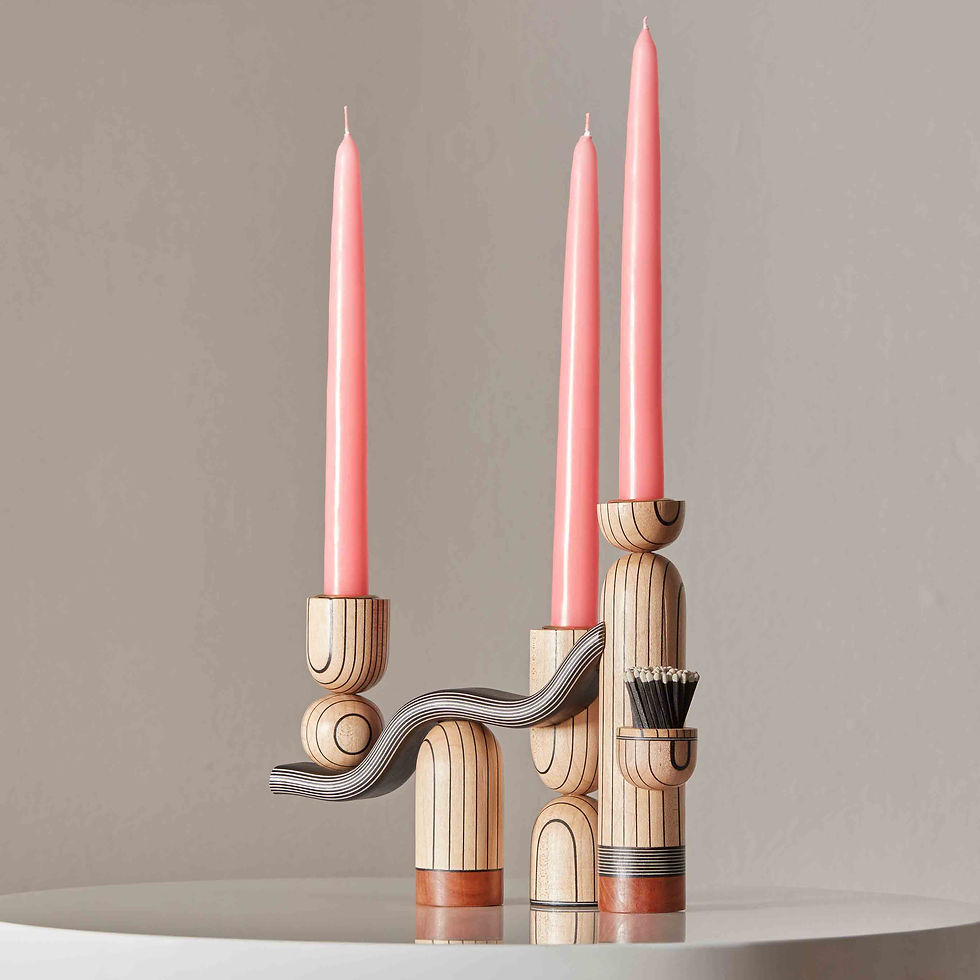
making these, I think, very meaningful but somewhat minor interventions in super traditional furniture by just adding a certain type of enameling to the glass component in an otherwise traditional bookcase, or putting a piece of unexpected marquetry in the back of a chair that was otherwise a reproduction of something in an American decorative arts collection.
If I look really closely at it, my experience being brought up by a family where there were no artists, it was really hard to convince them of art. They didn't see the value in it. They loved me, but they didn't see the value in it. And so, you want to be seen as valuable by the people around you. Even though they weren't into art, they could see the merit of craft. It was like, if they can't love what I'm making, at least they can be impressed by it. Eventually, that kind of faded out. I was like, this idea satisfying other people is never going to be the food I really need. So, I was like, all right, well, I'm going to have to make things that feel more authentically me.
It's not that technical craft has faded from my work, but it is definitely no longer the primary thing that makes it valuable. Whereas, it used to be this is idea like here’s a young woman who's really good at woodworking. That's what's amazing about her. And now it's like it has much more to do with the way that I’m re-contextualizing and reinterpreting and using this language.
I guess another way to put it would be that it used to be amazing that I could speak it at all. You know, and I think that that, again, it’s like a type of misogyny that people don’t recognize, like the kind of bear on the bicycle thing. I'm like, “If you thought it was normal for women to be good at this, you wouldn't be so excited about it.” Right? But I think that over time, it became not just amazing that I could speak the language, but what I was choosing to say with it.

That's where I hope it keeps going. It's definitely a more emotional ride and it feels riskier, but it feels more authentic. So I’m grateful. I also find that the places and spaces I end up in as I make this more experimental work, feel better for me. I don’t mind a fine woodworking conference, but I have found, like, I was a finalist for the Loewe Craft Prize this year, which was held in Madrid. They flew all 30 of us out and there was a big museum exhibition and we got to meet each other. Just meeting craft artists from all over the world who've been doing this their whole lives, showing off this one object that demonstrates their commitment and their love of this
thing, there were interpreters all around so we could talk to each other, I was like, this is doing so much more for me. This is a more correct place for me to be. I think we all know when we're eating food that's good for us versus when we're just getting by. So, yeah, I think that there's a lot of indications that it's the right path. But I’m charting this, so I don’t really know.
CINA : Just practically speaking, why do you feel it so important to cultivate heritage skills and craft with young people, today?
ASPEN : Well, I think we live in a material world, whether we acknowledge it or not. We're surrounded by materials and our consciousness and our physical lives are formed by the materials and the craft that produce the spaces we live in, the objects we live with and that enable us to live.
For people to lose track of that has almost an environmental effect. You may not notice right away that the sea levels are rising, but drop heritage skills from all curricula and close all learning centers, give it 30 years, we're not going to have beautiful homes. We're not going to have safe tools. It’s very hard to remember that the things that surround us also need to be known and understood and made in order to remain around us.

Someone needs to learn traditional masonry if we're going to keep having beautiful buildings. Those don't come out of nowhere. AI does not make those. It's not even something that's hard to argue for. It's something that's simple. If you want structures and objects with integrity, you have to train people to make those. Period.
CINA : Are you pretty much just living in the present, or do you have a picture of yourself and your work in the next 10 years?
ASPEN : I think there's kind of tiers of that, you know? If I'm super lucky, or if I'm medium lucky, you know? It's kind of like Maslow’s hierarchy of needs. At the bottom, the thing I hope to never
lose is access to my craft. That could mean simply just having enough hand tools and access to greenwood that I can simply keep doing it for myself. Beyond that, I'd love to keep teaching it and I'd love to keep getting better at it myself, building my own proficiency and skill sets.
Beyond that, I'd love to be of service to my community. If that means having employees who I treat well and who learn and can grow in my space, then that's great. If it means teaching at RISD, if it means teaching at Chairmaker’s Toolbox, whatever. Once I have that, then I would try to carve out space to make work that feels genuinely myself, like authentically me, you know?
Beyond that comes the opportunity to genuinely make a living at it in such a way that there's surplus, which then allows for the creation of a space like a shop or a studio that can platform more than just myself. That would mean having enough resources because my practice is thriving enough that I'm able to start up a shop with space for more than just myself and create opportunities for other people to pursue the same extremely challenging path. Basically, put some handholds on that slippery mountainside for some other folks.
I've been really lucky so far, and I don't think that it's out of the question that I’d be able to establish my own physical studio, like an owned space and make it big enough for more than just me, while also maintaining a craft practice that's at a high level of technical skill that’s historically informed, that’s culturally sensitive, and that is authentic to my interests and myself.
All of that is a lot. It's like a big stack, you know? But at the very bottom of that stack is something I know I've already got, which is the ability to just keep cutting the wood into shapes, sometimes for myself.

CINA : Speaking of cutting that wood into shapes, for anyone wondering why greenwood is so special, talk a bit about why that pursuit matters to you, why it is special.
ASPEN : Yeah, well, I think there are so many ways to approach that question, but I'm going to choose to put whoever is reading this in their body for a second and imagine the space of green woodworking versus the space of dry woodworking.
The space of dry woodworking, I don't know what else to call it other than that, but you begin by going to a lumber store, and you pick wood off a shelf, like going to the grocery store and picking the food that you want.
Then, you take it back in a truck to a shop that's pretty loud and it’s full of dust. You've got to put on your eye protection and your ear protection and your mask. So, you’re very insulated from the world. You're not able to talk to people or hear things and you begin a process of carefully planning out and then cutting things up precisely on very large machines. You're always going back to the same place. You're always outfitting yourself in the same sort of insulated way. In order to do your craft, you must be in this very specific room. You must protect your body in very specific ways.
In contrast, with green woodworking, you can start in a lot of different ways, but mostly, people start by going into the woods and identifying a tree, or finding wood, and then carrying it back, or dragging it back using a horse or a truck. I almost never have to wear ear protection or eye protection. I certainly never wear a mask because I don't make dust because I don't use sandpaper.
You start by splitting. You're standing there outside splitting a tree using iron wedges and a mallet. You're listening to birds, you're listening to cars go by, you’re talking to your friend who's helping you, and you're listening to the log open up. It’s just a very different day.
CINA : Where do you get your wood?
ASPEN : A variety of different places. I live in southern New Hampshire and I've got a sawyer who lives about an hour away who cuts trees. I call him up whenever I need a log. Luckily, I can get a lot of chairs out of one log, so I see him, depending on how much I'm making or whether I'm teaching a class that requires 12 chairs to be made a week, I may only see him four times a year. I go and see what he's got and we talk and chat. It’s very important to develop a relationship with a sawyer because, honestly, any big company or any big sawmill, they only profit when a veneer company comes, or a whiskey barrel making company comes and says, I'll take all of this white oak. They're standing like a hundred yards away and just pointing at some logs in the distance and they all get loaded up.
Somebody like me, I want one log, and I want to look at all of them, and I want them all to get moved around so I can see them closely. Then, ultimately, the log I buy is like max $300. So, you have to have a relationship, or they're not gonna work with you.
One of the things I did early in my career was to make one chair a year for the sawyer and drop it off as a way to be like, I really appreciate you and thank you. I know that they're losing money by selling wood to me a lot of the time.
CINA : I have so many more questions for you, but hopefully we'll have another opportunity to chat. I just want to end on one last question. When I say the word “purpose,” what does that bring up for you?

ASPEN : At this moment, I think most people's purpose is to feel emotionally and physically healthy and well. For me, right now, it's paying close attention to how things make me feel and then choosing amongst them the things that are best for me. So, for me, that's learning how to make exactly what I'm thinking of with the tools that I own and creating an environment or cultivating an environment in which I can do that indefinitely.
I think that wellness and self-expression are probably baselines for most people and the purpose is to find a way to do it that works for you, that hurts no one, and hopefully serves somebody else.
CINA : Nice. Beautifully said. Well, Aspen, thank you so much for time today. I just love your perspective, what you have to share and you’re heart. I’m so inspired. Is there anything else before we go?
ASPEN : I think that one of the last things I'll say is that the traction you start to gain when you're on the right path is another great indicator. You start meeting people who do this thing also, and you love them, and you start sleeping better, and you start finding that one skill leads to another, and they start to stack up, and you start to find places where you can do that thing, and those places start feeling like places you want to spend a lot of your time. You get sticky in the best possible way.
I got sticky around woodworking. It happens eventually. You find the right thing and it sticks to you.
CINA : I love that. The people that come when you start pursuing what it is that you're supposed to be pursuing is unmatched with how you meet people otherwise.
ASPEN : Again, I’ve tried all kinds of things. I loved book binding and I love my friends who are bookbinders, but I didn't find myself needing to go back to those spaces.
CINA : It’s funny that you bring up bookbinding! That's exactly what I’m currently exploring. That and basketry.
ASPEN : Yeah, there you go. But for some reason, you're dreaming about this way harder, not harder, but like way more challenging to get into, much higher cost of entry thing of woodworking. That's what I did. I'm like, whatever, I'll just channel this towards something more practical. But I was like, “I don’t think I can.”
CINA : Oh, that's so fascinating. Yeah, you’re right. You just have to get your hands on things, you have to try, and ultimately something is going to rise a little higher than everything else you’re working on.
ASPEN : I wish I loved drawing. It'd be so much easier. I wish I loved writing; you just need a laptop and a comfortable place to sit, but that's not it.
CINA : You found your “it.”
ASPEN : Hopefully, the it for this decade.
CINA : Right. Who knows where it might go. O.k., with that, I’m going to let you go. Thank you so much for sharing!
ASPEN : Yeah, and good luck with everything, congratulations on starting the center and finding your thing.
CINA : Thank you so much. And best wishes with everything. I hope we get to do this again!
To learn more about Aspen and her work, visit https://www.aspengolann.com/.
Comments